
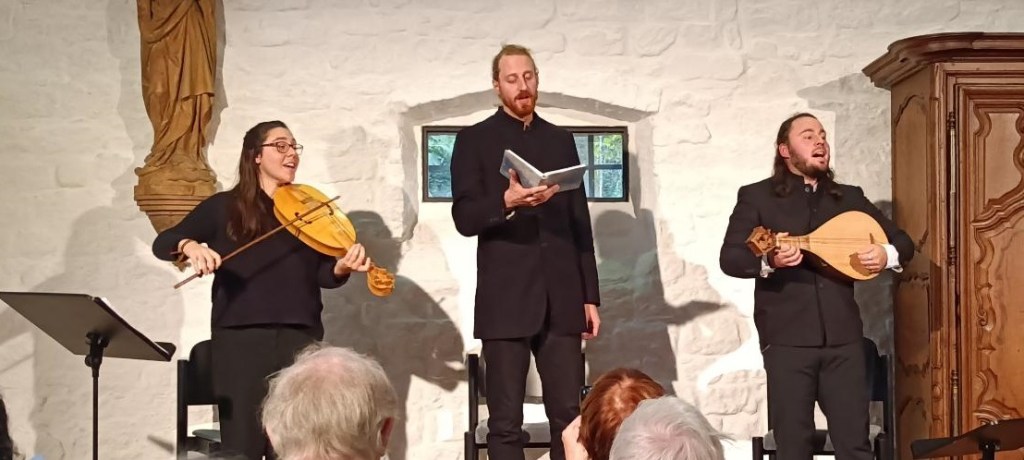
Que será de min?
Love songs from the Portuguese court

ensemble analógion’s first programme is exclusively dedicated to the late 13th century courtly love songs by King Dinis I. of Portugal.
Que será de min (what shall happen to me?): The concert follows the paradox of courtly love, leading the knight from joy to despair and finally to salvation. In content typical songs in troubadour style, their melodies are remarkable: Highly melismatic, they re-shape the poems and create an intriguing and challenging relation between text and music. The seven songs with melody are presented along instrumental arrangements from the song’s melodic vocabulary and the Cantiga de Santa Maria “Quen dona fremosa” (nr. 16), leading to the knight’s final salvation.
analógion performed Que será de min so far in Germany and Austria.
gradus dignitatis
Stories from St. Emmeram

For the medieval society, the legends and adoration of Saints was of enormous importance, since the Saints were seen as mediators between heaven and earth. With gradus dignitatis (grades of dignity) ensemble analógion tells the story of St. Emmeram with chants from the 11th century Saint’s office composed at the monastery of St. Emmeram in Regensburg. While the ensemble emphasizes the telling of the Saint’s stories, the new style of chant apparent in the office is partly extended by polyphony according to the sources describing contemporary organum techmiques.
extollemus cantica
missa tropata barcinonensis

With extollemus cantica, ensemble analógion offers the audience a window into 14th century France, presenting the polyphonic so-called “Mass of Barcelona” in the style of Ars Nova.
In difference to the famous contemporary mass cycle by Guillaume de Machaut, the Mass of Barcelona is troped, inserting comments and statements of adoration between the original words of the ordinarium of the Mass. The Mass of Barcelona therefore is a witness of 14th century devotion.
The polyphonic ordinarium in performance is completed with the proper chants from the Missa Sollemnitate Sanctissimae Trinitatis that was introduced in 1334.
 ensemble analógion